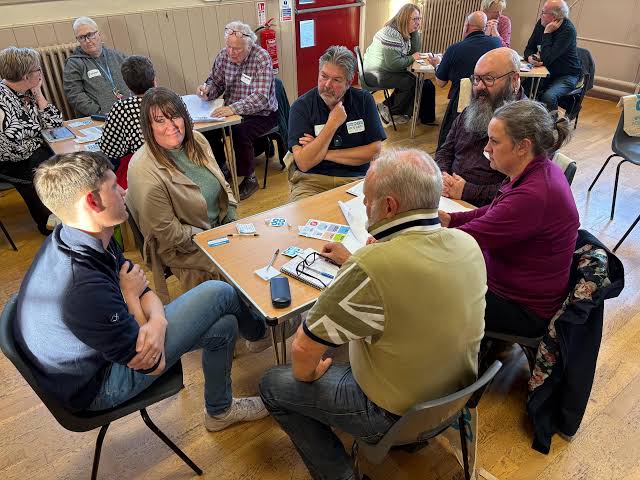
The groups that do well on hum are set up well before anyone opens the app. They know who they are, what they are for, and who will hold the process together.
This piece is for partner organisations and local leaders thinking about starting a community fund. It covers the conditions that give a group the best chance of lasting, and the choices worth making early.
The short version: hum is one part of the picture. It provides the technology: a shared treasury, a way to propose and decide together, and a live record of where the money goes.
The rest is people. Partner organisations act as community builders, and local stewards do the work on the ground. They build the relationships, run the gatherings and hold the process together. The technology and the community building both have to happen. Neither works without the other.
1. Choose a purpose that small money can move
The most important decision is what the fund is for. hum works best when local people can make a real difference with small amounts of money, again and again.
Good purposes are ongoing. They are never "finished", and they are made of many small actions rather than one big one. For example:
Loneliness and connection: a weekly shared meal, a walking group, transport so an older neighbour can get to the community lunch.
Wellbeing: a men's fitness session, a parents' drop-in, art materials for a youth group.
Environment: tools for a community garden, plants for a stream clean-up, a seed library, a repair café.
Local food: a shared growing plot, a preserving workshop, a pantry restock.
Each of these can be funded with small amounts of money. Each one is visible to the people who funded it. And each one helps create the next idea.
Why not a building project?
A project to build something, such as a new hall, a playground or a skate park, is a poor fit. It needs one large sum, a long lead time and professional delivery. The community makes one big decision and then waits a year or more.
That breaks the loop that makes hum work. People need to see their decisions turn into something real, quickly and often. Small grants do that. One large capital project does not.
If a building project matters to your community, hum can still help around it. The fund could pay for the events, gatherings and care that bring people together to raise the money while the bigger project is controlled / funded elsewhere.
A simple test
Ask: Could ten different people each do something useful with small grants (for example 50 to 500 $/£) toward this purpose? If yes, it is a good fit. If the answer is "only once we have the full amount", look again.
Every grant becomes a story
One of the best side effects of an ongoing purpose is that every microgrant ends with a short update. On hum these are not compliance paperwork. They are stories that celebrate what the community made happen.
Over time those stories add up to a living record of the fund. With the community's permission, they can be shared beyond the group: with local residents, businesses, councils and other funders. People can see in real time where the money went and what it did. An example of a community that have made this public (a setting in hum) is Mohua in New Zealand.
That transparency is persuasive. It is how a fund that starts with one funder can attract contributions from local people and businesses who see the benefits and want to be part of it. A one-off building project produces one story at the end. An ongoing fund produces a steady stream of them.
2. Start with trust, or be ready to build it
The quickest starts come from groups that existed before hum arrived. They already meet, talk and look out for each other. hum gives that existing trust a budget.
hum can work with new groups too. But be honest about what that takes. A group brought together by a funding offer needs traditional community-building work before and alongside the app: knocking on doors, hosting gatherings, finding the natural connectors and listening to what people care about.
Skip that work and every proposal becomes a test of trust rather than a decision about money. Do it well and the fund becomes one of the things that holds the new group together.
A useful question: If you took the app away, would these people still meet and make decisions together? If yes, you can move quickly. If not, plan the relationship work and resource it properly. That is the job of your partner and stewards, not the software.
3. Draw a clear boundary
Everyone needs to be able to answer one question easily: who is in? Uncertainty about membership is one of the fastest ways for a community fund to lose legitimacy.
The boundary can be a street, a village, a school community, a cultural group or a self-formed group with a shared interest. What matters is that it is simple to explain and simple to check. hum currently supports one form of membership per community, so start with one clear rule.
The best boundaries pass three tests:
Shared consequence: what the group decides lands on the group itself, not on someone else.
Mutual visibility: members can see who decided what, and each other's stake in it.
Self-definition: the group drew its own edge. It was not drawn around them by someone else.
Size is not the point. A few streets can work. So can a group spread across a city that shares a real common purpose. What breaks a fund is a boundary drawn for administrative convenience, with no relationships behind it.
4. Agree a simple constitution
The constitution is the agreement the community makes with itself about how the fund will work. It includes what the fund is for, who can join and what the money can be spent on. It can also cover the group's shared values, how decisions are made, how disagreements are handled and how the rules can change. It is short, written in plain language and visible to every member. The hum software now makes it really easy to build / refine a constitution.
The constitution turns good intentions into decision rules. When a proposal arrives, anyone can check whether it fits. That settles most disagreements before they start, and it gives funders confidence too.
Start conservative. Keep the purpose focused and the spending rules clear. You can loosen them later as trust and confidence grow. A constitution is meant to change as the group learns.
5. Find your stewards and your partner
hum provides the infrastructure. Community builders provide the relationships. Software alone will not hold a community fund together, and two human roles carry most of that work.
Stewards look after the process, not the money. They uphold the constitution, approve new members, run meetings and handle the odd edge case. They do not decide what gets funded. The community does that. Key steward decisions need more than one steward to agree, so no single person can take control.
Good stewards are trusted, patient and good at bringing people along. One or two is enough to start. In early days, someone from the partner organisation can act as steward until a community member is ready to take it on.
A partner organisation connects the community to funders and keeps things running. This might be a local charity, a council team, a community centre or a trust. Partners often hold the funds, make payments when proposals pass, train stewards and help sort out problems.
Partners must be local. They are already trusted by the community and already known to funders. Evidence from our pilots is clear on this point: a strong local intermediary is one of the biggest factors in whether a fund takes root.
6. Line up a funder and a rhythm
A fund needs a funder who has agreed the terms before launch. That means a committed amount, a payment schedule and a clear understanding of how the model works.
The key thing a funder has to accept is this: once money is in the community treasury, the community decides how it is spent, within the constitution. The funder can see every decision and every payment in real time. If the fund is clearly used outside its agreed purpose, future payments can be paused. But the funder does not approve each micro-grant.
Regular smaller payments work better than one large sum. They lower the risk for the funder, build trust step by step and give the community a steady rhythm. Think of it as a tap rather than a bucket.
hum is designed to run continuously, with ideas and proposals moving all the time. In practice, most communities also need a regular cycle, such as a monthly gathering or a quarterly check-in, where people look at what has been funded and what comes next. Build that rhythm in from the start. Continuous flow and a regular cycle work together.
7. Keep meeting in person
The app records decisions. Meetings are where people talk them through.
Regular face-to-face time keeps the process understood and keeps people involved. It is where new members learn how things work, where quieter voices get heard and where disagreements get resolved before they harden. It's where relationships get built.
It also helps with voting. hum uses a multi-proposal time-based approach, where the community is always comparing multiple options and support for any proposal builds up the longer people back it. This rewards steady commitment over last-minute campaigns. But it can feel puzzling at first. A short explanation at a meeting does more than any help page.
8. Sort the practical details before launch
A few practical questions are worth settling early:
Access: can everyone in the group use the app? Think about phones, data, language and confidence with technology. Plan support for anyone who needs it.
Payments: who holds the money, and how does it reach the person running a funded activity? Agree this with the partner and funder before the first proposal passes.
Legal and procedural: are there rules the funder or partner must follow? Check them now, not after the first grant.
Visibility: will the fund be public, or kept within the group? Agree when grant stories can be shared outside the group, and who gives permission. Decide and tell everyone.
Testing: run a short trial with a few members before opening to everyone. Fix the confusing bits first.
Are you ready? A quick checklist
Our purpose is ongoing, and small amounts of money can make a visible difference to it.
The people involved already know and trust each other.
We can say in one sentence who is in the group.
We have a draft constitution: purpose, membership and spending rules.
We have at least one steward willing to look after the process.
We have a trusted local partner.
A funder has agreed an amount and a payment schedule, and accepts that the community decides.
We have a regular time to meet in person.
We know how payments will reach people, and everyone can access the app.
You do not need every box ticked on day one. But the more you can tick, the better your fund's chances.
The communities that thrive on hum are not the biggest or the best resourced. They are the ones that already care about each other and about a shared purpose, and that use small, regular amounts of money to keep acting on it. If that sounds like your group, we would love to talk.