
This guide walks through every setting in the Community Currency module: what each one does, what we default to, and what to think about before you change it. It assumes you have already decided you want a community currency.
If you are still deciding - if you are not sure whether your community needs one at all, or what problem it actually solves - start with What if your community had its own currency? instead. That one is the why. This one is the how.
One important caveat before you start. There is no single right way to run a community currency. People have been doing this for decades under a dozen names - LETS schemes, timebanks, mutual credit networks, local paper currencies, care banks - and they differ on almost everything: whether an hour is always an hour, whether balances are allowed to go negative at all, whether anything expires, who issues, who decides. Some are backed by national currency; most are not.
What follows is one design: mutual credit, hour-based, with limits that grow as you contribute and balances that gently fade if you stop. We think it holds up well for a neighbourhood-scale community (15-100 people). It is not the only sound answer, and if your community already has a tradition that works, trust that over anything here. Hum is designed to be very flexible and the chances are you can adjust the settings to fit what you want, if not, there are other tools to help.
For this document, we are assuming you are a community administrator who wants to set up a new community, no economics knowledge assumed. Nearly every decision below is reversible, and the community can get you to change it later, so often our advice is to just go with the defaults and get people trading. A currency dies of no activity far more often than of a badly chosen number.
The one idea you need
There is no pot of money. Nothing is bought or funded. The currency is created the moment two people help each other.
When Anna mows Ben's lawn for 1 token, Ana goes up by 1 and Ben goes down by 1. Nothing was added or removed - the total is still zero. Every member's balance plus the community treasury always adds up to exactly zero. That is the whole system, and it is why it cannot run out.
A positive balance means someone has given more than they have received. The community owes them time.
A negative balance means someone has received more than they have given. Completely normal - it is how the currency starts working at all, and it is never a debt to chase.
One hour of anyone's time is worth 1 token. A doctor's hour and a gardener's hour are the same. The smallest unit is 0.1, about six minutes (if you want that could also be the cost of a cake at a community fund raising stall)
Why the settings are shaped the way they are
Elinor Ostrom won a Nobel Prize for studying communities that share something - a fishery, a forest, an irrigation system - and work out how to look after it without anyone being in charge. She found that the ones lasting for generations all did the same handful of things: they drew clear boundaries around who was in, they made what you take relate to what you give, they let the people affected set the rules, they made everything visible, and they responded gently before responding firmly.
Most of the settings below are one of those principles turned into a number. You never need to learn the framework, but if you ever wonder why a setting exists, that is the answer.
What happens when you switch it on
Turning Community Currency on does three things:
Members see the currency in the app - wallet, offers, wants, balances.
The community gets a steward manual written for a mutual-credit currency, if it does not already have one. You can edit it freely afterwards.
Sensible starting settings are applied: earned credit limits and balance decay are both switched on.
Switch the module off and on again and nothing is overwritten - your settings and the stewards' manual are kept exactly as they were.
General
Token name
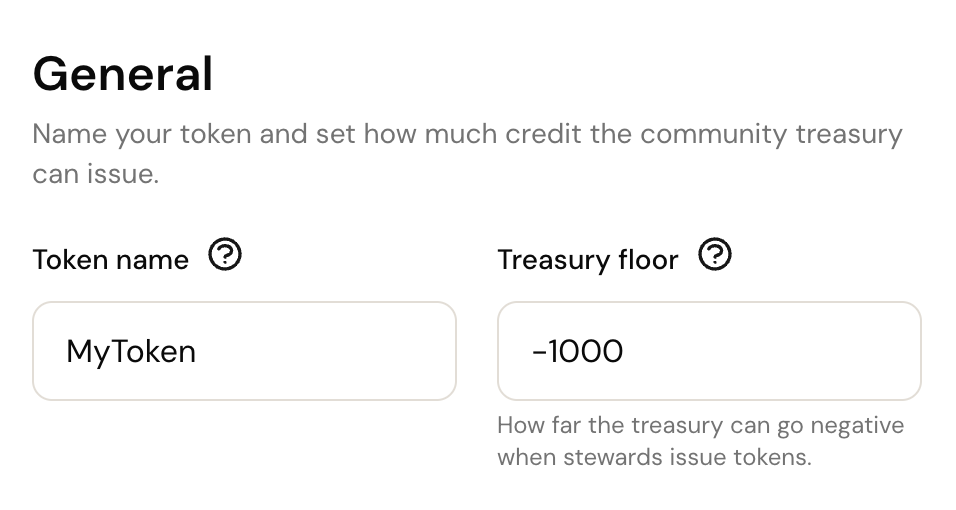
What members see their balance in. Give it a name that belongs to the community - a local word, a landmark, an in-joke. Choose it before people start trading; changing it later is harmless technically but confuses everyone mid-flow.
Treasury floor
The community treasury is its own account, and it goes negative when stewards issue tokens - because issuing creates credit that members have not yet worked off. This setting is how far it may go.
Think of it as the community's overdraft for paying people to do community work. Too tight and stewards cannot reward anything; too loose and a community can issue far more than its members will ever work off. A rule of thumb: no more than a few hours of work per member. For 20 members, somewhere between 100 and 500 is plenty.
Credit limits
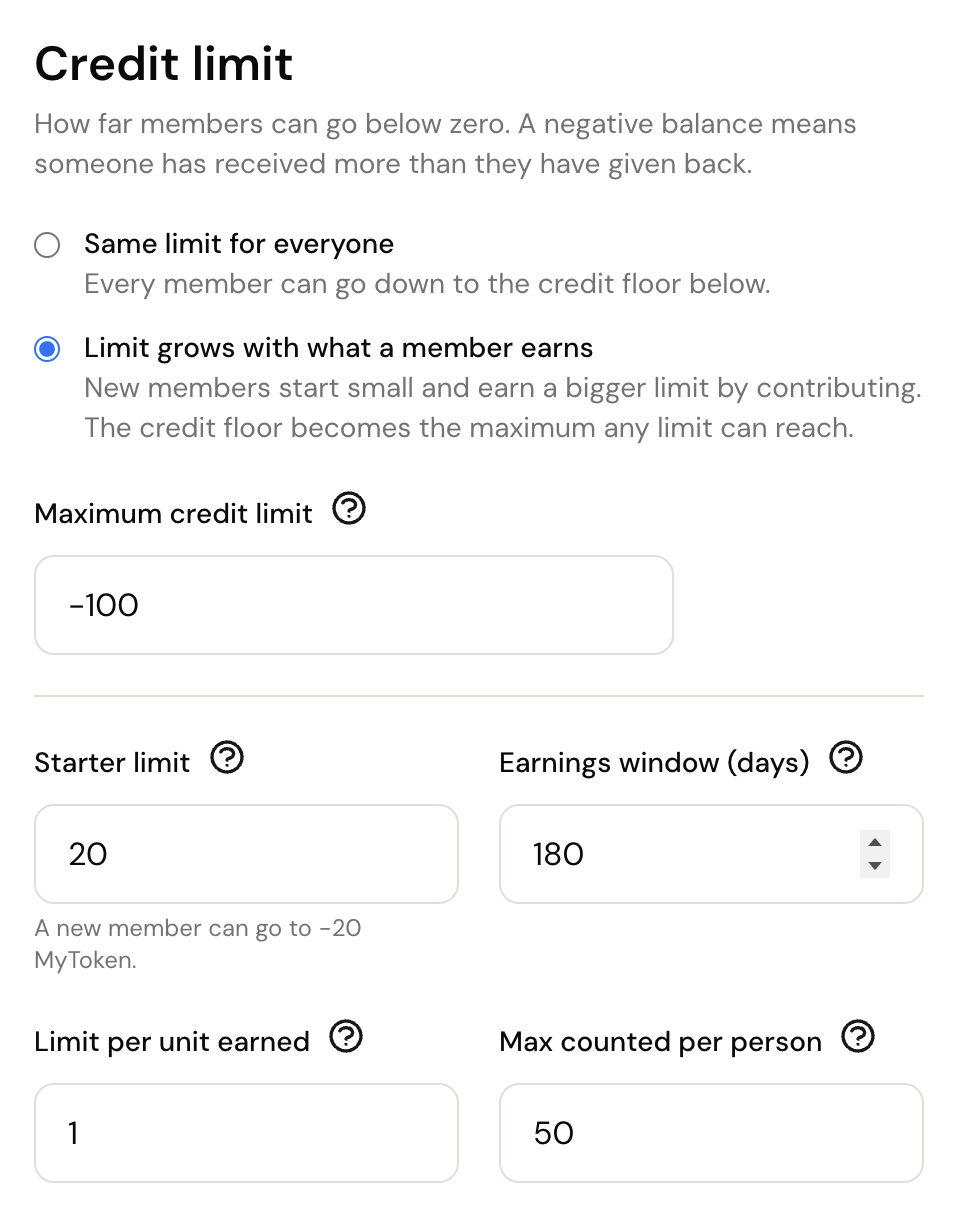
A member's credit limit is how far below zero they can go - how much they can receive before giving anything back. This is the most important choice you will make.
How limits are worked out
You have two options
Same limit for everyone gives every member the same floor. Simple, and fine for a small group who all know each other.
Limits that grow with what a member earns - the default - start new members small and extend their limit as they contribute. Someone who has shown they give back is trusted with more; someone who just arrived, or who stopped taking part, is trusted with less. The app works this out on its own; you never set an individual's limit by hand.
Pick the growing option unless your community is small and tight-knit enough that everyone genuinely vouches for everyone.
Maximum credit limit
With one limit for everyone this is the limit. With growing limits it becomes the ceiling - the furthest anyone can ever go, however much they earn. It is also your protection against people gaming the system, so do not set it very loose just to stay out of the way.
Starter limit
What a brand-new member with no earnings can go negative. Do not set this to zero. A new member who cannot ask for anything until somebody happens to buy from them first is the single most common reason people join a community currency and never come back.
Earnings window
How far back earnings count. A rolling window means a limit reflects what someone is doing now, not what they did years ago - and it tightens again if they drift away. Nobody is ever stranded by this: a limit is never pulled tighter than what a member has already spent. They are simply held still until they earn again.
Limit per unit earned
How much extra credit each token earned unlocks. At 1, earning 30 raises the limit by 30. Higher extends credit faster; the maximum still caps it.
Max counted per person
The most that earnings from any single member can add to a limit. Without it, two people could send the same amount back and forth - netting to zero but each banking the full amount as "earned" - and inflate both their limits for free. With it, trading with several people counts for more than trading a lot with one, which is what you want anyway.
A worked example. Priya joins. Her limit is -20, so she can ask for help worth up to 20 straight away. Over two months she does jobs for four neighbours and earns 60. Her limit becomes -80: the 20 starter plus 60 earned. Had all 60 come from one neighbour, only 50 of it would count and her limit would be -70.
Balance decay
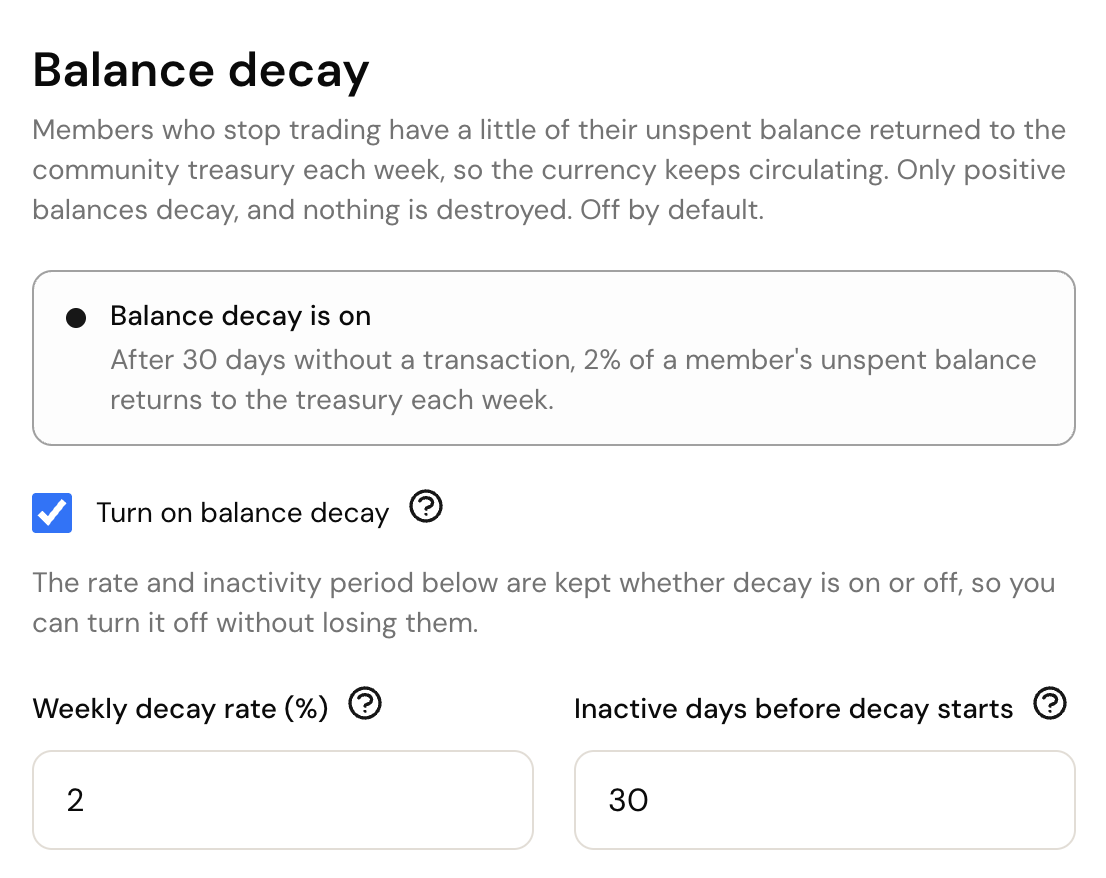
A currency is only useful when it moves. If members build up positive balances and sit on them, the currency stops working - their surplus is somebody else's stuck commitment. Decay gently returns idle balances to the community.
The switch
While off, balances are never reduced whatever the rate says - and the rate and inactivity period are kept, so you can turn decay off and back on without setting it up again.
Weekly decay rate
The share of a member's remaining positive balance that returns to the community treasury each week once they have gone quiet. It compounds, so small numbers add up: at 2% an untouched balance halves in about eight months; at 5% it halves in about three. Start low - you can always raise it.
Inactive days before decay starts
How long a member can go without sending or receiving before their balance starts decaying. Any transaction resets the clock, so a member who trades even occasionally never sees decay at all.
"Isn't this punishing generous people?" It can look that way, because a high positive balance means someone gave a lot. The honest answer is that they are being nudged to receive, not penalised for giving - and the practical response is helping them find something they actually want.
"Why don't negative balances decay too?" Because that would be interest. It would grow what someone owes faster than they can work it off, which pushes people out rather than drawing them back.
The one thing to watch. Decay feeds the community treasury every week, and nothing spends it back out automatically. If stewards never issue anything, the currency slowly drains from members' hands into an account nobody spends from - the opposite of what decay is for. Make sure the stewards know that a growing treasury is a job, not a success.
Where the tokens actually go
Before you hand this over, it helps to be able to draw the whole system on the back of an envelope. There is exactly one shared account - the community treasury - and everything else is members trading with each other.
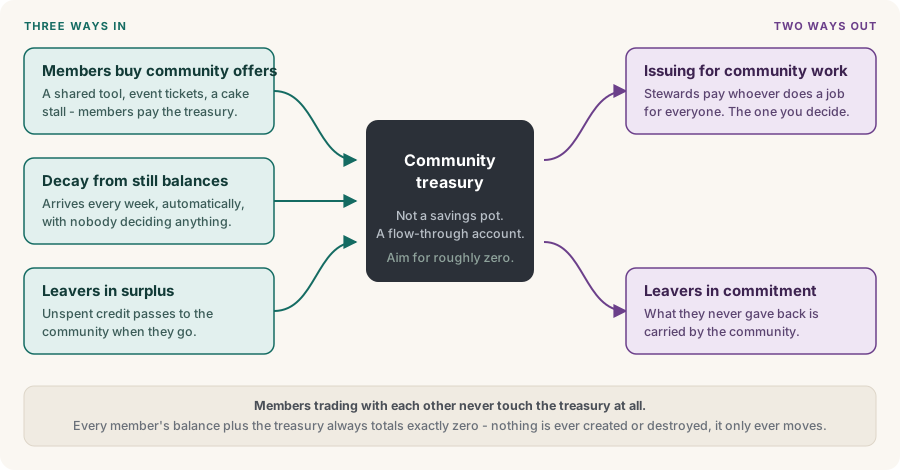
Three ways tokens flow in. Members pay the treasury for something the community itself provides - use of a shared tool, tickets to an event, a cake stall. Decay arrives every week from balances that have stopped moving, without anyone deciding anything. And a member who leaves while in surplus passes their unspent credit to the community.
Two ways they flow out. Stewards issue tokens to recognise work done for everyone, or to honour a decision the community made. And when a member leaves while in commitment, what they never gave back is carried by the community - which is exactly why credit limits matter.
Only one of those five is a decision anyone makes. The other four happen on their own. That is the single most useful thing to tell your stewards: the treasury fills itself, but it only empties if somebody chooses to spend it. A treasury that keeps climbing is not a healthy surplus - it means the currency is draining out of members' hands into an account nobody spends from.
Nothing here is ever created or destroyed. Tokens only move. Every member's balance plus the treasury always totals exactly zero, which is the one check worth doing if you ever wonder whether the books are sound. The treasury is allowed to go negative - that just means the community has issued credit its members have not yet worked off - and the treasury floor is how far you let that go.
Categories
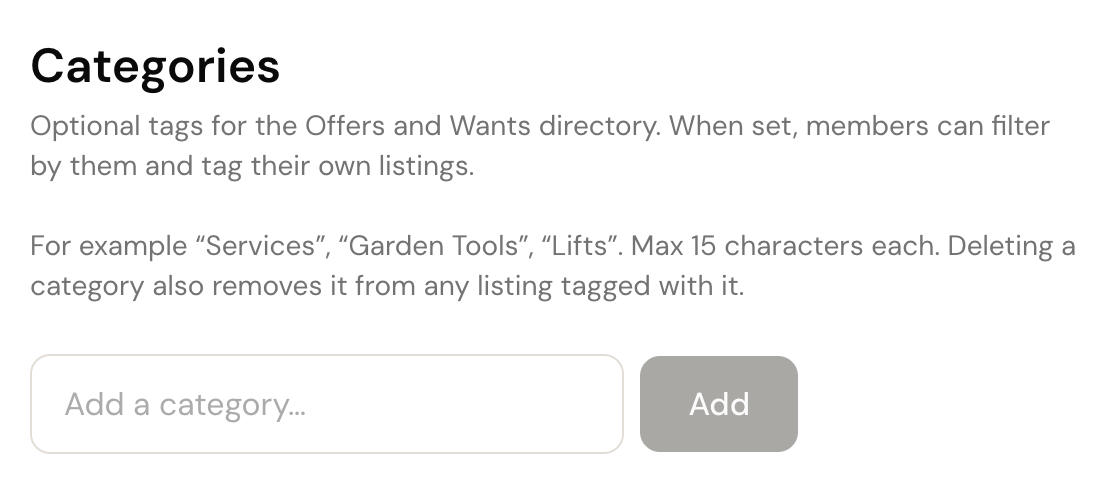
Optional tags for the Offers and Wants directory - "Lifts", "Garden", "Childcare". Members can filter by them and tag their own listings.
Leave them empty at first. A directory with eight listings does not need filtering, and categories chosen before you know what people actually offer tend to be wrong. Add them once the directory is big enough to be hard to scan.
Handing over to the stewards
Everything above is a starting position, not a rule. The communities that thrive are the ones where the people living under the settings are the ones who adjust them.
Stewards get their own manual (accessed via the app) seeded automatically, covering the day-to-day: welcoming members, watching for stuck balances, looking after the treasury, handling disputes. Everyone sees these so everyones expectations are the same regarding the stewards responsibilities.
Every balance, credit limit and treasury movement is visible to every member. That transparency is the point - trust comes from openness, not from stewards having authority.
Review the settings together after a few months. If decay is making people anxious, lower it. If new members cannot get started, raise the starter limit.
If you only do one thing: get five people to make one real exchange in the first fortnight. Settings matter far less than that. A currency with perfect settings and no trades is dead; one with rough settings and a dozen active members will sort its own numbers out.
A sensible starting point
If you would rather not think about any of it, these are the defaults and they work for most communities:
Token name: Koha, or your own
Treasury floor: -1000
Credit limits: grows with what a member earns
Maximum credit limit: -100
Starter limit: - 20
Earnings window: 180 days
Limit per unit earned: 1
Max counted per person: 50
Balance decay: on, 2% a week, after 30 inactive days
Categories: none to begin with
Setting this up well is mostly about getting out of the way. Pick the defaults, name the token something people like, and spend your effort on the first few exchanges rather than the numbers.