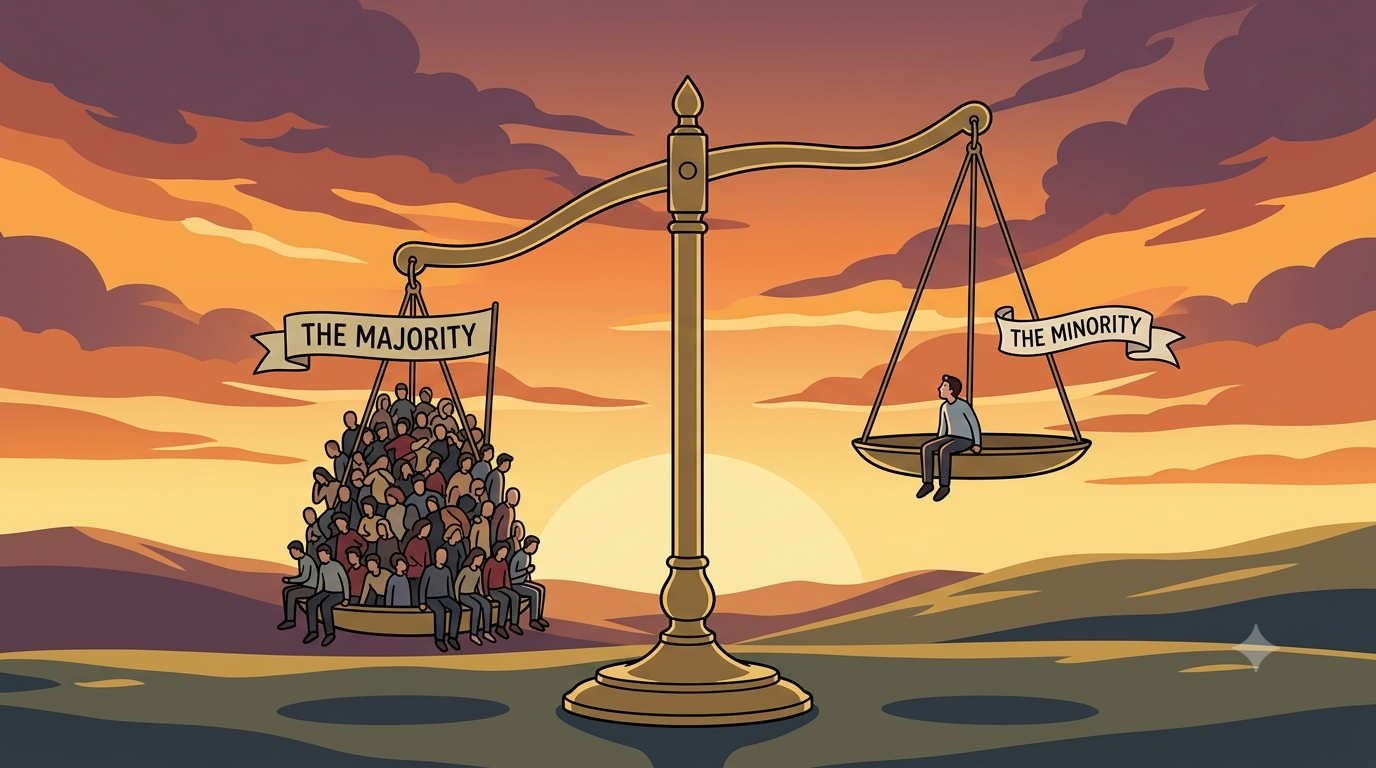
How hum's governance protects the 49% from the 51%
There's an objection to democracy that's older than democracy itself. Plato put it bluntly around 380 BC: give power to the majority and they'll simply vote themselves the benefits and send the bill to everyone else. Twenty-three centuries later the critique hasn't changed much. We hear it regularly when we talk about community governance:
"So the 49% will just have to pay for whatever the 51% want?"
It's a fair challenge, and it something we have given a lot thought. Majorities can bully minorities - history is full of examples. But Plato's alternative was to hand power to unaccountable experts, and history has even more examples of how that goes wrong. The philosopher Karl Popper offered a better frame: the real test of a governance system isn't whether it always makes wise decisions (no system does), it's how quickly and peacefully it detects and corrects bad ones.
That's the test we design for at hum. Here's how our two governance models already partly address the tyranny of the majority problem - and the two new features coming shortly to close the gap further.
Gov1: where a committed minority can actually win
In our earlier post on quadratic and conviction voting we described how hum's first governance model works: every member gets the same pool of voting credits, the cost of piling votes onto one proposal rises quadratically, and votes gain strength the longer they're held - your "conviction" builds over days, following a half-life set by your community.
Notice what this combination does to the 51/49 problem:
Sustained commitment beats momentary numbers. In a simple show-of-hands vote, a minority loses every time. Under conviction voting, a small group that cares deeply - and keeps their votes parked on a proposal week after week - steadily accumulates influence that a distracted majority never bothers to match. A minority group in your community doesn't need to out-number anyone; they need to out-care them, which on issues affecting them directly, they almost always do.
Passion is priced honestly. Quadratic voting mean nobody, majority or minority, can cheaply dominate everything at once. You can love one proposal, really like two, or spread yourself thinly across ten. A majority faction that wants to steamroll every decision burns through its credits fast.
Thresholds scale with the ask. A proposal's passing threshold in Gov1 isn't a flat 50%. It scales with how much of the community fund the proposal wants: small % asks need modest support, larger asks need much more, and a proposal asking for more than the community's agreed maximum share of the fund simply cannot pass - no matter how big the majority behind it. A 51% bloc cannot vote itself the whole treasury. The maths won't let them.
Gov2: representation without the populist loophole
Our second governance model option adds representative democracy: members elect stewards who make day-to-day funding decisions on the community's behalf. Delegation is efficient - but isn't this exactly where a charismatic populist takes over by pandering to the majority?
Three design choices make that strategy expensive:
Electing a steward costs quadratically too. Members use a dedicated credit pool to back stewards, with the same quadratic voting. A passionate faction pouring everything into one demagogue pays a steep price for that depth, while broad, moderate support across the community stays cheap. Populism is an intensity strategy - quadratic voting taxes intensity.
Trust must be sustained, not surged. A steward's voting weight isn't set on election night; it's their supporters' conviction, accumulated over time and decaying when withdrawn. Populist support is high-amplitude and short-lived - a viral moment, an angry meeting. Conviction, by contrast, is support added up over time - like a battery that only charges while trust is held, and drains when it's withdrawn. One hot week doesn't buy real power; months of maintained trust do. Communities worried about capture can even lengthen the conviction voting half-life, quite literally turning an anti-populism dial.
There is no safe window for pandering. The classic populist exploit in national politics is the electoral cycle: promise anything, win, then face no consequences for four years. In Gov2 there is no cycle. Members can move their steward votes the day a promise fails to materialise, and the steward's weight starts draining immediately. Accountability isn't an event every few years; it's continuous.
Write it down: your constitution should name the money's purpose
Mechanisms matter, but so do words. The single cheapest protection a community can give its minorities is a clear, specific constitution - and the clause that matters most is the one about money.
Don't just write "funds will be used for the benefit of the community." A durable majority can read "the community" as "most of us" with a clear conscience. Write it explicitly: community funds exist to support minority groups within the community as well as majority priorities. Name it. Make supporting the few a stated purpose of the pool, not an act of charity the many may grant or withhold.
This does two things. It gives any member proposing minority-supporting work firm constitutional ground to stand on - they're not asking for a favour, they're pointing at the founding agreement. And it reframes every funding debate: the question stops being "why should we pay for them?" and becomes "this is one of the things our fund is for."
What's next on our roadmap
The mechanisms above handle volatile majorities well. The harder case is a patient, durable 51% bloc that maintains its conviction and consistently steers the pool toward itself. Two new optional features, being released shortly, are aimed squarely at that case.
Exit rights: the majority can't profit from driving you out
Borrowed and adapted from the "ragequit" mechanism pioneered in the Web 3 DAO world: when a funding proposal passes, there's a challenge window before the money moves. During that window, any member who dissented can choose to exit the community with their fair, pro-rata share of the treasury.
This quietly transforms the majority's incentives. Under plain majority rule, exploiting the 49% is profitable - you gain their contribution and their compliance. With exit rights, a proposal that alienates half the community can shrink the pool by up to half. Pandering to "us" at the expense of "them" becomes self-defeating before the vote is even cast. Like a good nuclear deterrent, the power of exit rights lies mostly in never needing to be used: its existence alone disciplines what gets proposed.
Community referral: an emergency brake in members' hands
The ancient Romans had an answer to powerful decision-makers: the tribune of the plebs, an officer of the ordinary people who could halt any act of the Senate. We're designing the modern equivalent.
If a steward-approved proposal troubles enough ordinary members - a petition representing a meaningful share of the community's voting credit, gathered within the challenge window - the proposal is suspended and referred to a vote of the full membership, where it must clear a supermajority to proceed.
Stewards keep the efficiency of day-to-day delegation. Members keep an emergency brake that no steward can take away. And because triggering a referral costs real voting credit, it can't be spammed to grind governance to a halt, it's reserved for the decisions that genuinely alarm people.
Nothing here is final — and that's the point
Political scientists call it "losers' consent": people accept losing a round when they believe the system genuinely lets them contest the next one. That belief is what the 51/49 objection assumes away - it imagines one final, zero-sum vote after which the losers are stuck.
Hum's answer to Plato isn't a promise that majorities will be wise. It's a design in which nothing is final: conviction shifts daily, stewards are always recallable, constitutions name minorities as beneficiaries of the common pool and, as these next features land, alarmed members will be able to refer decisions back to everyone, and anyone who truly loses faith will be able to walk away with their fair stake honoured, which is precisely why communities will work hard to make sure nobody wants to.
Democracy's oldest bug doesn't get fixed by finding better rulers. It gets fixed by better mechanism design. That's the work we're doing.
Gov1 (continuous quadratic + conviction voting) and Gov2 (steward-based representation) are both live in hum today. Exit rights and community are coming soon. if you'd like your community to help shape their design, get in touch.